
A capital-efficient path to compact fusion power
We harness the physics of solar flares, magnetic eruptions larger than Earth, to bring fusion within reach at a fraction of the size and cost of today's mega-facilities, on hardware that sells valuable products long before the power-plant endgame.
Fusion's cost problem is a physics problem
Mainstream fusion heats entire plasmas to hundreds of millions of degrees, which demands megajoule lasers, billion-dollar facilities, and decades of engineering. The hardest fuel of all, proton-boron (p-11B), needs roughly ten times more energy than deuterium-tritium, which is why most ventures avoid it despite its decisive advantage: the reaction produces charged particles instead of neutron radiation, enabling direct electricity conversion and reactors without heavy shielding.
Don't heat the plasma. Accelerate the protons.
Rosette Energy sidesteps bulk heating entirely. Eight laser spots arranged in a ring generate self-magnetized plasma bubbles. Where neighboring bubbles collide, their opposing magnetic fields annihilate through magnetic reconnection, the same mechanism that powers solar flares. Each reconnection site acts as a natural particle accelerator, launching protons to fusion-relevant energies while the surrounding plasma stays cold.
In our simulations the bulk plasma never exceeds a few tens of eV, four orders of magnitude below the thermal requirement, confirming that every fusion-relevant proton is reconnection-driven.
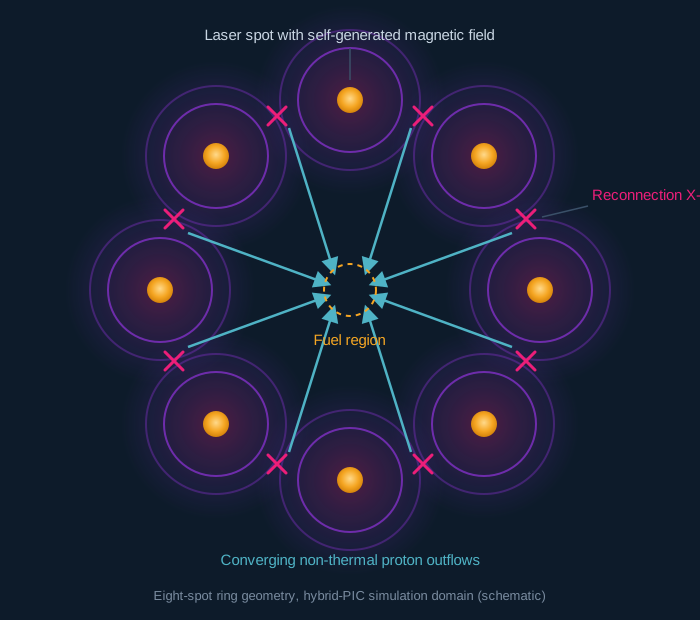
Eight-spot ring geometry: anti-parallel field lines reconnect at eight X-lines whose outflows converge on the fuel.
What the simulations show
All results below are from first-principles hybrid particle-in-cell simulations (WarpX) and are simulation-conditional. Experimental validation at an open-access laser facility is the next milestone.
A near-term market before the power plant
Every laboratory seeking to replicate or extend these results needs joule-class picosecond laser systems, multi-spot phase plates, precision beam delivery, and diagnostic optics, all commercially available today. Rosette Energy's architecture is built around tabletop-scale photonics rather than national-lab infrastructure, making the technology an immediate demand driver for the photonics supply chain.
Joule-class picosecond drivers with multi-spot phase plates for university and national-lab teams reproducing the ring geometry.
Kilohertz-class amplifier chains with the thermal management needed to move from single-shot physics to continuous operation.
Fast proton spectrometers, x-ray imaging, and Thomson scattering suites calibrated for reconnection-driven signatures.
Milestones, not timelines
- 01Simulation platformComplete
- 02Peer-reviewed publicationUnder review
- 03Experimental validationAt an open-access facility
- 04Multi-ring scalingRep-rated operation
Founder
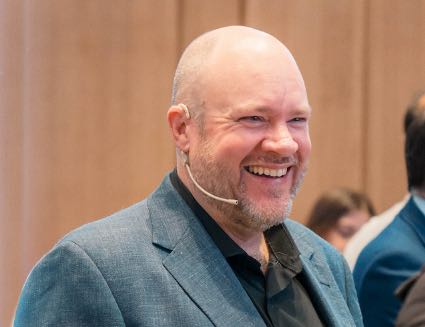
James B. Worth is a serial entrepreneur, inventor, and AI researcher who has spent two decades building companies and a patent portfolio valued in excess of $100M — and never stopped thinking about nuclear fusion.
His obsession with fusion began as an undergraduate studying Aerospace Engineering at the University of Colorado Boulder. It stayed with him through a career that took him from defense systems and investment banking to founding Substrate AI and SubGen AI, European AI companies that have raised over €39 million including a €19.1 million investment from the Spanish Government. Along the way he became an inventor on multiple issued US patents spanning machine learning, reinforcement learning, and agentic AI systems.
When the simulation tools finally caught up with the idea, he built the ring-reconnection fusion platform from scratch — theory, hybrid-PIC simulation, analysis pipeline, and IP. His 2026 manuscript is under review at Physics of Plasmas, with accepted presentations at APS-DPP, ECLIM, and ISPBF.